
Brand After Humans
For five thousand years, every brand decision ever made had one thing in common: a human was at the end of it.

A Mesopotamian potter stamping clay. A Victorian soap manufacturer putting his name on a wrapper. A copywriter writing a beer commercial. A Nike brand manager briefing an agency. The channel, context and content changed. But the audience was always human.
Until just now.
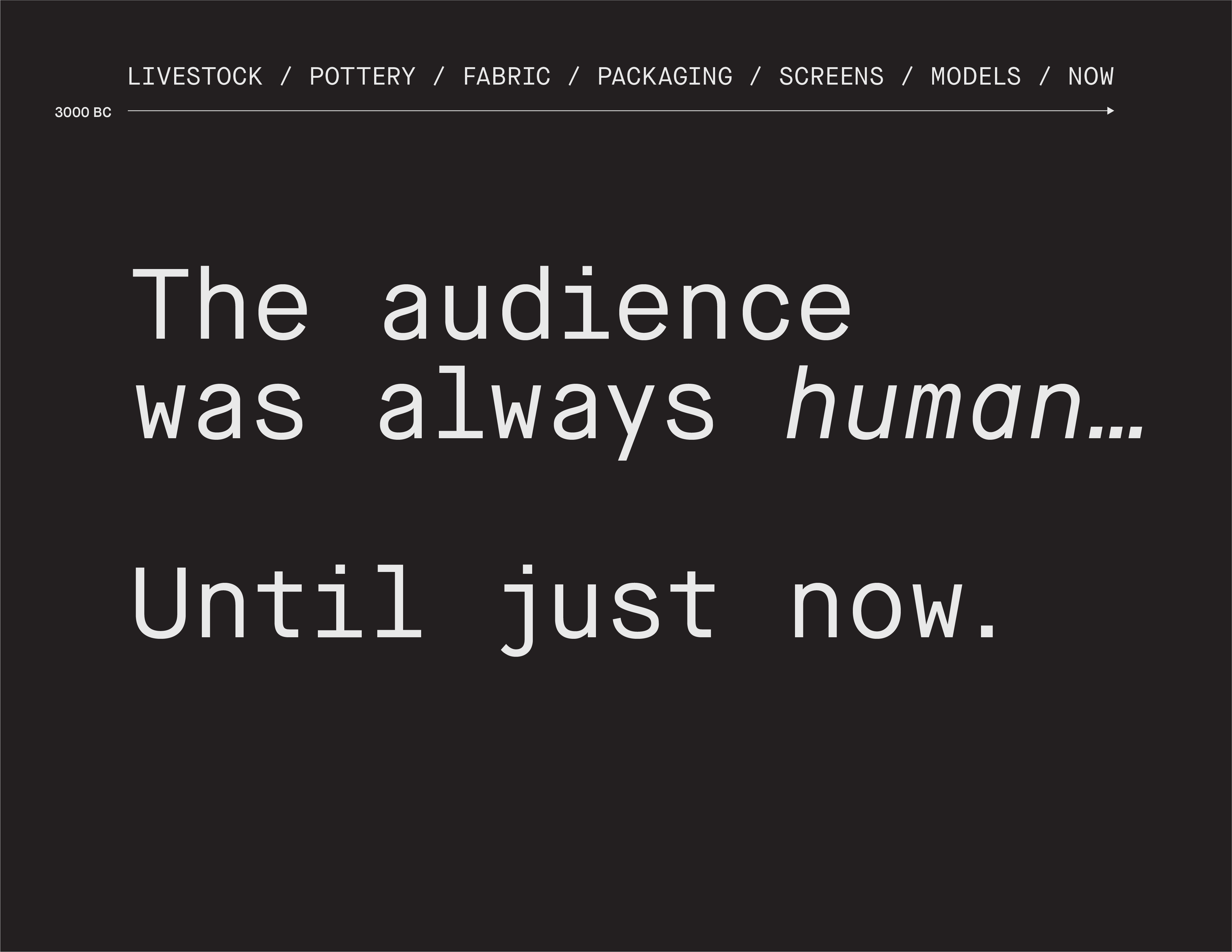
The word “brand” comes from the Old Norse ‘brandr’, meaning to burn. A mark of ownership. Pressed into livestock to prove what belonged to whom. Ancient Egyptians were doing it 4,000 years before the Common Era. Before writing, before money, before most of civilization’s defining inventions — humans were burning marks of trust into things of value.
That instinct evolved but never left us.
Medieval guilds required craftspeople to mark their wares. The Industrial Revolution turned those marks into trademarks. Mass production created distance between maker and buyer, and brands bridged that gap with familiarity and trust. Coca-Cola didn’t just sell sugar water — it sold a feeling. Marlboro didn’t sell cigarettes — it sold an identity. By the late 20th century, brand had become the most valuable intangible asset a company could own.
The underlying logic was always the same: create a signal that lands in a human mind. Build recognition. Build emotion. Build preference.
Kevin Roberts said it cleanly: “The essential difference between emotion and reason is that emotion leads to action and reason leads to conclusion.”
Brand was the discipline that turned reason into emotion, and emotion into commerce. It worked because the audience was always human.
We’re now in an era where AI is reshaping how brands are ‘built’. The best teams are using it to collapse the distance between insight and execution. Living brand systems (responsive, generative, adaptive) are replacing static style guides. Designers are becoming conductors of models rather than makers of layouts.
This adaptation is real and necessary. But it’s not the disruption.
The disruption is something more seismic
Right now, as you read this, AI agents are making purchasing decisions.
Amazon Rufus is filtering product recommendations for millions of shoppers daily. Perplexity is answering *”what’s the best running shoe for flat feet?”* and serving a brand without a human forming a single search query. Autonomous agents are being handed corporate budgets and told to procure. Purchasing systems are using AI to evaluate vendors before a human ever sees the shortlist.
For the first time in the 5,000-year history of brand, the thing choosing the product might not be human.
Think about that.
Google users are less likely to click on a link when they encounter search pages with AI summaries
% of Google searches in March 2025 that resulted in the user…
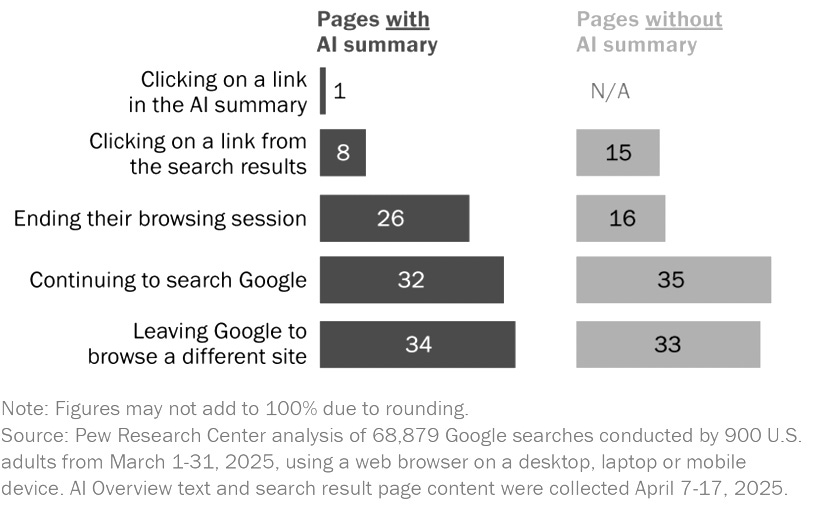
When AI summaries appear in Google search results, users are nearly half as likely to click through to a website — dropping from 15% to 8%. The machine answered the question. Your brand never got a look in. Source: Pew Research Center, 68,879 searches, March 2025.
Every brand on earth was built for human perception. Visual identity designed for human eyes. Packaging engineered for human hands. Brand voice crafted for human emotion. Copy written for human cognition.
None of it was architected for a machine evaluating your product against ten thousand others at millisecond speed — cross-referencing structured data, semantic associations, contextual signals.
The machine doesn’t feel the heritage of your brand. It doesn’t respond to your color psychology. It can’t be moved by your origin story. It parses ‘information’ and it decides based on how clearly your brand communicates to it.
This is not an SEO problem.
The industry is already naming the tactics, AEO (Answer Engine Optimization), GEO (Generative Engine Optimization) and the forward-thinking agencies are selling them. Those things matter. But tactics aren’t strategy. Optimization isn’t architecture.
What’s missing is the brand side of the equation. The structural question that should determine everything else:
Does your brand know itself clearly enough that a machine can understand it?
Not optimize for it. Not trick it. Understand it.
The brands that will win the next decade aren’t the ones that bolt on the right metadata or hire the right SEO consultants. They’re the ones that have done the hard, foundational work of knowing who they are — so completely, so consistently, that their identity is soft and hard coded into both the physical and digital world with such clarity that an LLM can understand it without ambiguity.
That’s a different problem than GEO. It’s a brand problem. Specifically, a brand clarity problem.
Here’s what makes this a paradigm shift and not just a new channel:
Brand ambiguity used to be survivable. Humans can be inconsistent and fluffy, so we built brands to be. Brands are, after all, reflections of human values, personalities, archetypes and behaviors.
Humans forgive inconsistency. We fill in gaps with our own optimism and goodwill. We assume positive intention and give the benefit of the doubt. We meet brands halfway because we’re becoming emotionally invested in the relationship. A fuzzy brand was a strategic problem — something to fix eventually, something you could get away with while the market was forgiving.
Machines don’t forgive. They work with what’s there. They don’t fill gaps — they flag them, skip over them, or fill them with someone else’s answer. A machine has no patience, no goodwill, and no room for ambiguity. It reads the record and builds a picture from what it finds.
Which means brand ambiguity is no longer just a strategic liability. It’s a structural one.
What happens when a brand optimizes for AI
Black Friday and Cyber Monday 2025 after redesigning content for AI-readable discovery and understanding.
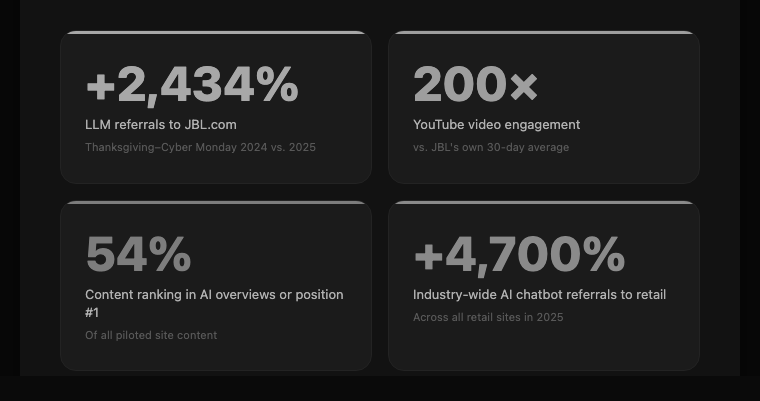
The proof is already in the numbers. JBL, the audio equipment maker, quietly rebuilt its brand architecture for AI-readable discovery last year — structuring content around how language models understand categories, not just how humans search. During Black Friday and Cyber Monday 2025, referrals to JBL’s website from large language models were up 2,434% year-over-year. One brand. One deliberate shift in how clearly it communicated its identity to machines.
Results are only from one quarter but that’s still a pretty mega signal.
ChatGPT.com vs Gemini.google.com
Outgoing referral visits, Sept 2024–Nov 2024 vs Sept 2025–Nov 2025, Worldwide
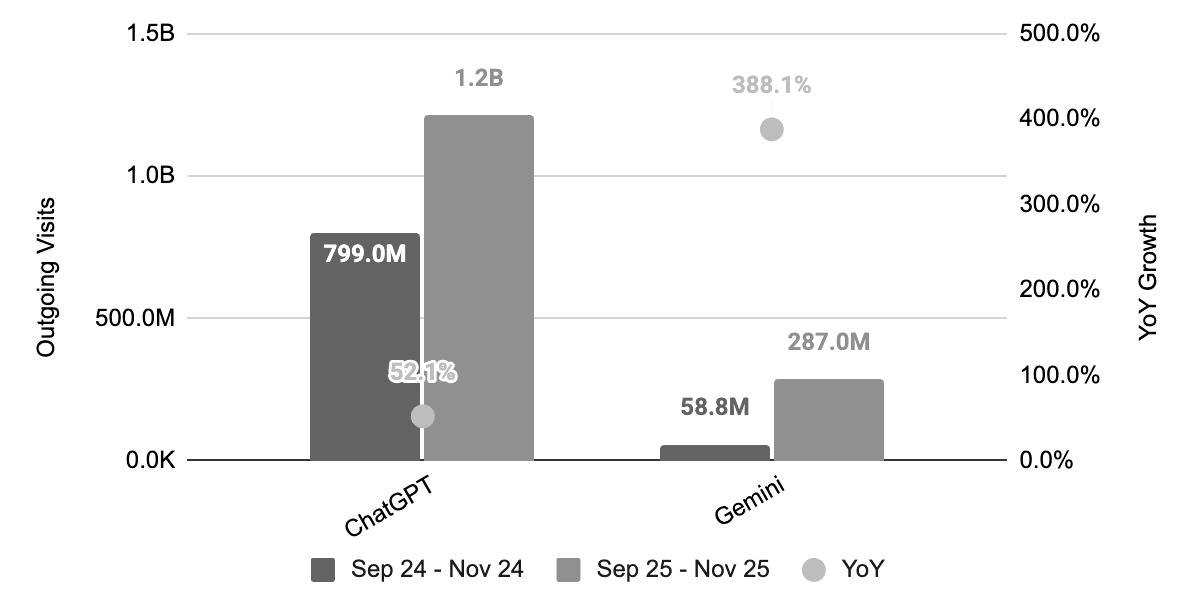
ChatGPT sent 1.2 billion referral visits in Q4 2025 — up 52% year-over-year. Gemini grew 388% in the same period. These are platforms recommending products and brands to hundreds of millions of people, right now. Source: Similarweb via Digiday, Sep–Nov 2025.
So what does “brand clarity for machines” actually mean? It has three dimensions — and they build on each other.
The first is structural. Is your brand identity expressed in forms a machine can parse? Structured product data. Consistent taxonomy. Schema markup. Clean, complete attributes. This is table stakes — good hygiene. Without it, your brand has no foundation on which to build. Brands can fail here not because they’re careless, but because they built everything for human eyes and never thought about machine-readability. The story lives in campaigns, in beautifully designed PDFs, in copy that humans feel and machines skim past without parsing.
The second is semantic. When a language model is asked about your category, what does it think about you? Does it describe you the way you’d describe yourself? Your brand has a footprint in training data whether you shaped it or not. The question is whether that footprint matches your positioning or distorts it. If your brand says “premium” and your reviews say “cheap” — the machine sees that gap instantly. If your positioning says “sustainable” and your supply chain data says otherwise — the machine knows.
The machines we are unleashing will be more brutal than humans. We encounter a brand maybe a few hundred times in your life and construct a forgiving, impressionistic view. A machine cross-references thousands of data points in milliseconds. Authenticity stops being a personal preference and becomes a structural advantage. Coherence stops being aspirational and becomes measurable.
The third is brand experience. The brands with the deepest machine legibility aren’t the ones with the best-optimized metadata. They’re the ones that did the slow, hard, irrational work of building genuine human love over decades — because that work left a map. A trail of connected moments captured by people and their own digital footprints.
Every time a human had a real brand moment and wrote about it, reviewed it, recommended it, argued for it in a group chat — that became a data point. The emotional residue of real brand love is also, it turns out, the richest possible machine signal.
Mention density. Machines don’t have memory the way humans do — but they have the aggregate record of what humans said. Volume and consistency of sentiment over time creates a signal that machines read as significance.
Trust proxies. Machines (probably?) don’t feel trust — but they calculate something that functions like it. Review depth, recommendation frequency, third-party validation, the specificity of how people describe your brand when nobody asked them to. A machine builds a confidence score the way a human builds a gut feeling. Different inputs. Same function.
Authentic emotional signatures. Genuine emotion leaves different linguistic patterns than manufactured emotion. Brands that people actually love get described differently than brands people tolerate. The vocabulary is different. The specificity is different. The frequency is different. A machine reading a million mentions can distinguish authentic brand love from marketing noise — not because it understands love, but because love produces a different data signature.
The punchline: everything you build for human hearts is now also being read by machine logic. The gap between those two readings is where brands will win or lose.
Ask yourself: if an AI agent was tasked with finding the best premium pet food for a senior dog with joint issues — would it find your brand? And if it did, would your brand architecture tell it the right story?
Not: do you have good metadata? Not: have you done GEO?
Does your brand know itself clearly enough that the machine doesn’t have to guess? And, if it wasn’t obvious already, this should be good for humans too. Who doesn’t want clearer choices to inform decision-making?
Conversion Rates by Channel
Comparison of sign-up and subscription conversion rates across traffic sources.
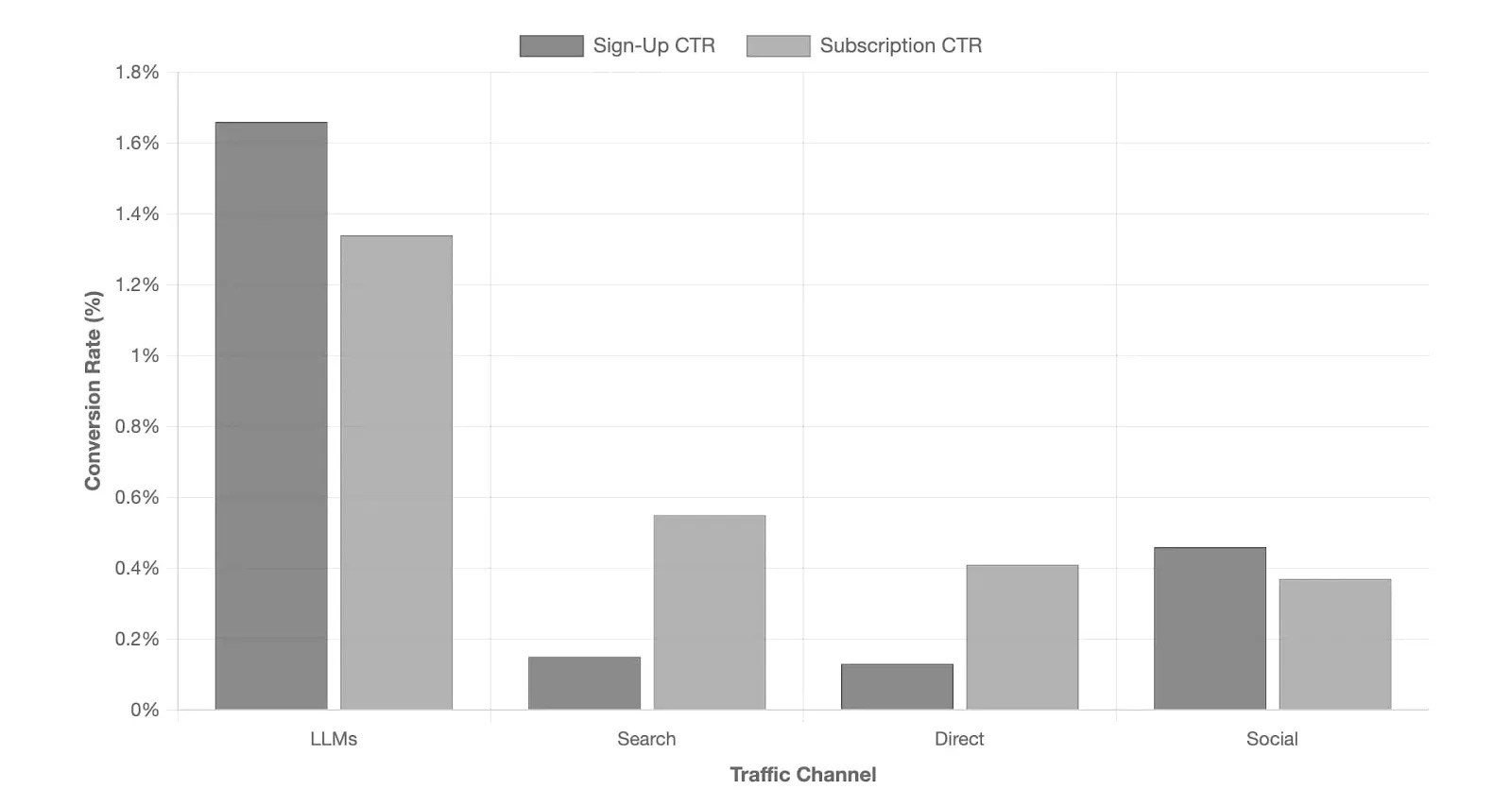
Traffic from LLMs converts to sign-ups at 1.66% — vs 0.15% from search. More than 10x. The brands that get found by AI don’t just get more traffic. They get better customers. Source: Microsoft Clarity, analysis of 1,200+ websites, 2025.
There is one exception worth naming.
A small class of brands will choose deliberate machine-illegibility. Hermès doesn’t optimize for algorithmic discovery. You can’t buy a Birkin through an AI agent. The friction is the point. The scarcity is the value. For these brands, the fact that a machine can’t access them becomes the ultimate luxury signal: this brand exists only in the human world.
But that’s available to a fraction of a percent of brands on earth. It requires a level of desirability and scarcity that most brands simply don’t have. For everyone else, the question isn’t whether to become legible to machines. It’s whether you’ve built the brand identity that makes legibility possible.
I’ve spent my career at the intersection of brand, design, innovation and business. I’ve seen brand dismissed as decoration and celebrated as strategy. I’ve argued — and proven — that brand is a structural margin engine, not a marketing cost. Get the brand right, and the financials follow. That belief hasn’t changed.
What’s changed is the audience.
For 5,000 years, brand was a conversation between humans. A mark burned into something of value, read and trusted by another human on the other side. The discipline was built entirely around that exchange.
That exchange is no longer exclusively human.
The brands that will win aren’t just the ones with the clearest human proposition. They’re the ones that know themselves so well — so completely, so consistently — that the clarity is embedded in everything they do and everywhere they exist. Soft and hard coded into the physical and digital world. Legible not just to the people they’ve always served, but to the machines that are increasingly choosing for them.
Brand has always been about burning a mark of trust into something of value.
The audience has just changed.
Jared Richardson is a brand strategist and design leader. Former SVP, Global Head of Design of a Fortune 200 CPG, he believes good brand is good business and that belief is about to get tested in ways nobody planned for.
In a recent article in Ad Age, Lindsay Ritenhouse shares how Code and Theory are building GEO strategies (Generative Engine Optimization) to drive client growth. A great example is JBL, the audio equipment maker. Last year they rebuilt their brand architecture for AI-readable discovery, structuring content around how language models understand categories, not just how humans search. During Black Friday and Cyber Monday 2025, referrals to JBL’s website from large language models were up 2,434% year-over-year. This demonstrates how one brand has made a deliberate shift in how it communicated to machines.
Sounds like a new age of reckoning coming for marketing our products. Great introduction to the topic thanks.